
ºIts been awhile since I have posted. I have been busy wrapping up things with my teaching career and beginning retirement. I am now semi-retired. Even though I am no longer a full time teacher, I have dedicated most of my time to my former high school as a substitute, a math tutor, a music director and a subtle math coach. By math coach, I mean that I offer help with planning to try out activities and assist core math teachers with planning.
So now I am getting back into an old plan to walk through Euclid’s Elements one proposition at a time also watch for activities and lesson plans for second semester Algebra I. I will reenter the ancient text in the first book at proposition 13. Euclid stated this proposition as “ If a straight line set up on a straight line makes angles, it will make either two right angles or angles equal to two right angles”. Of course, he is referring to a linear pair equaling 180 degrees. And in his typical Euclidian way, he refuses to say 180 degrees, but rather says “two right angles”.
OK lets look at some drawings:
In figure 1 Euclid stated the objective as follows: “ I say that the angles CBA, ABD are either two right angles or add up to two right angles. In Modern Geometric Notation, we would say:
m∠ABC + m∠DBA = 180º
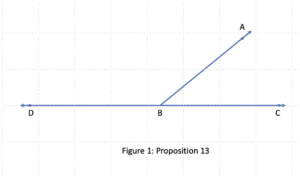
This may seem obvious and not worthy of a proof, but in order to use it in further proofs, we must do a rigorous objective proof. So here is how Euclid did it.
If angle CBA is equal to ABD, they are two right angles (180°). But, if not, then we need figure 2 where line segment BE is drawn perpendicular to CD.
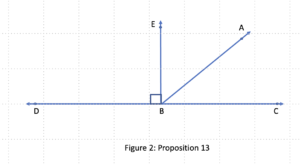
From Figure 2:
(1) m∠CBE + m∠EBD = 180°
and
(2) m∠CBA + m∠ABE = m∠CBE
Therefore, By Subtitution:
(3) m∠CBA + m∠ABE + m∠EBD = m∠CBE + m∠EBD = 180°
We can also say:
(4) m∠DBE + m∠EBA = m∠DBA
Now add mÐCBA to each side of (4)
(5) m∠CBA+ m∠ABE + m∠EBD = m∠DBA + m∠CBA
Combining (3) and (5)
(6) m∠CBE + m∠EBD = m∠DBA + m∠CBA = 180°
Rewriting (6)
(7) m∠DBA + m∠ABC = 180°
QED